From your first niyyah to a confident daily routine — everything you need to begin Islamic homeschooling with clarity, calm, and a strong Quran foundation.
Book a Free Quran Trial Lesson
The decision to homeschool rarely arrives all at once. It usually builds quietly — a comment a child brings home that doesn't sit right, a school calendar with no room for what truly matters, a growing wish to make faith the centre of learning rather than an afterthought. Across the UK, the United States, Canada, and the Netherlands, more Muslim families than ever are choosing to educate their children at home, and that number has risen sharply over the past decade.
In Islam, teaching a child is never just academic. The very first word revealed to the Prophet Muhammad ﷺ was اقْرَأْ — "Read." Raising a child upon knowledge and faith is an amānah, a trust from Allah, and it is among the most rewarding work a parent can undertake. This guide walks you through that work, one practical step at a time — what to do first, how to choose a curriculum, how to build a routine that flows around salah, what it really costs, and how to keep your niyyah alive when the days get hard.
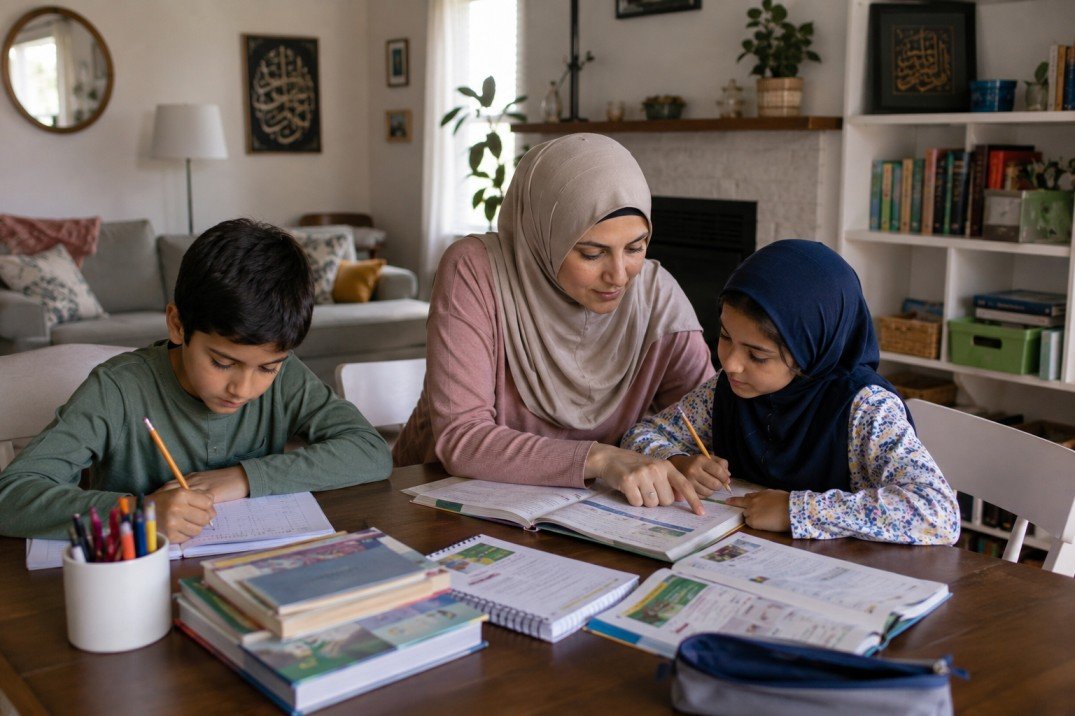
When one Muslim mother first chose to homeschool her children, she wasn't searching for the easiest path. As a mother of five, she knew it would require commitment, patience, and careful planning. What she didn't expect was how deeply the journey would shape both her children and her family.
After homeschooling for more than eight years, she openly admits that Islamic homeschooling isn't effortless. There are days when lesson plans don't go as expected, toddlers interrupt learning, and household responsibilities compete for attention. It takes organisation, flexibility, and a willingness to adjust when life doesn't follow the schedule. Yet despite every challenge, she describes the experience with one unforgettable phrase:
"It is unfathomably worthwhile."
Why? Because homeschooling gave her something she couldn't find elsewhere — the opportunity to make Islam part of everyday life rather than just another subject on the timetable. Instead of separating faith from education, her children experienced Quran, Islamic manners, and daily worship as a natural part of learning. Family discussions, shared meals, outdoor activities, and even ordinary moments became opportunities to strengthen their relationship with Allah.
Her story also reminds new homeschooling parents of an important truth: you don't have to create a perfect classroom at home or become an expert in every subject before you begin. Homeschooling is a journey of learning alongside your children, improving little by little, and building a home where both knowledge and faith grow together. If you're feeling overwhelmed by the idea of starting, her experience offers an encouraging reminder: homeschooling isn't easy — but for many Muslim families, the lifelong rewards make every challenge worthwhile.
Islamic homeschooling is no longer a fringe choice. The reasons families give are remarkably consistent, and understanding them will help you clarify your own "why" before you start.
Both paths can raise faithful, well-educated children. The right choice depends on your family's circumstances, not on which option is "better" in the abstract.
| What matters to you | Islamic School | Islamic Homeschool |
|---|---|---|
| Daily faith integration | Scheduled into set periods | Woven through the entire day |
| Pace of learning | Set by the class | Set by your child |
| Parent time required | Lower | Higher — but flexible |
| Cost | Often fixed tuition | Adjustable to any budget |
| Socialising | Built-in daily | Through co-ops, masjid & activities |
| Quran focus | Shared with a class | One-to-one possible |
If you decide homeschooling fits your family, you don't have to teach every subject alone. Many parents anchor the academic day themselves and bring in specialists for Quran and Arabic — for example through a structured online Quran recitation and Tajweed course for kids taught by qualified, Al-Azhar–certified teachers.
Still deciding? Ask yourself three honest questions: Do I have the time and energy to lead the day? Can I source good help for what I can't teach? And does my child currently thrive in a classroom, or struggle in one? Your answers will point the way.
Homeschooling is legal across the UK, the US, Canada, and the Netherlands — but the requirements differ widely, even between states and provinces. Sorting this out first saves a great deal of stress later.
Check your specific country, state, or province before you begin, and connect with a local homeschooling network — experienced families are the fastest way to understand what your area actually expects.
Curriculum is a tool. A vision is the reason you pick up the tool. Write down — even in a few sentences — what you hope to produce, and let that guide every later decision.
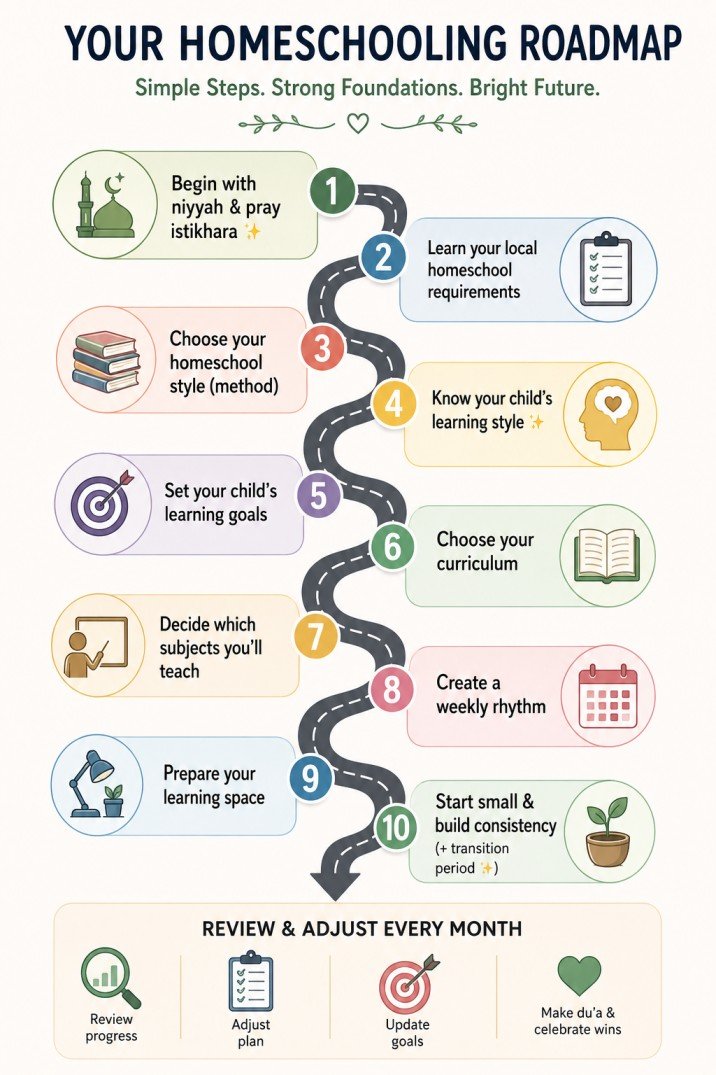
Every successful Islamic homeschool follows a similar path. Here is the full roadmap — ten clear steps from intention to a working routine.
Before logistics, begin with the heart. Make a sincere intention to educate your children for the sake of Allah, and pray istikhara asking Him to guide your decision and make it a source of barakah. This first step is what turns homeschooling from a stressful task into an act of worship — and it's what you'll return to on the hard days.
Confirm the legal steps for your country, state, or province: notification, record keeping, and any assessments. Get this settled early so you can teach with peace of mind.
Explore the main approaches — classical, Charlotte Mason, Montessori, unit studies, child-led, and eclectic. You don't have to commit forever; pick the one that fits your child and your temperament, and adjust later.
Notice how your child absorbs information best — visually, by listening, or through hands-on activity. Matching your methods to their style removes much of the friction from daily lessons.
Translate your vision into a few concrete goals for the term — a Quran target, a reading level, a maths milestone. Goals keep you focused when the day feels scattered.
Select resources that match your goals and budget. You can use a ready-made Islamic curriculum, build your own, or blend both. Don't over-buy at the start — begin lean and add as you learn.
Prioritise Quran and core literacy and numeracy first, then layer in Arabic, Islamic studies, science, and the rest. Not everything needs to start in week one.
Home thrives on routine and flexibility. Aim for a predictable sequence — the same subjects in roughly the same order — with room to follow a child's curiosity when it strikes.
You don't need a dedicated classroom. A clean corner, a small shelf, and good light are enough. What matters is a space that signals "we learn here."
Begin with two or three subjects and your Quran routine, then build. Children leaving school often need a short deschooling period to adjust — that's normal. At the end of each month, review what worked, drop what didn't, and adjust calmly.
A balanced Islamic homeschool curriculum weaves faith and academics together rather than treating them as separate worlds. These six areas form the core.
Quran comes first — in scheduling, energy, and priority. Give it the best part of the day, when your child is fresh. Arabic unlocks deeper understanding of the Quran. Islamic studies work best as a thread running through the whole day, not a single isolated lesson. Core academics — reading, writing, maths, science, history — still need to be taught properly. Character (akhlaq) and life skills complete the picture. For a deeper breakdown of subjects, providers, and how to put it all together, see our detailed Islamic homeschool curriculum guide.
Good resources make homeschooling lighter. Build your toolkit from a mix of the following — and remember you don't need all of it at once.
Quran recitation is the one area where unqualified teaching can quietly embed mistakes that are hard to undo later. This is where many families bring in expert help — Zaid Academy offers live, one-to-one Quran and Tajweed lessons with Al-Azhar–certified Egyptian teachers, including female teachers, designed to fit neatly into your home routine.
One of the most common worries is money — and the honest answer is that homeschooling can cost almost nothing or scale up as far as you like. It is often more affordable than private Islamic school fees.
Most families land in the middle, spending the most on the things hardest to teach at home — typically Quran and Arabic. Start lean, see what your family actually uses, and invest where it matters most.
One of homeschooling's quiet advantages is that the day can be built around worship instead of squeezing worship into the gaps. Here is a simple rhythm that maps onto prayer times for an elementary-age child.
Keep the day predictable but not over-scheduled. Three focused hours of real instruction for a young child, followed by reading, projects, and free play, achieves more than six hours of forced bookwork. During Ramadan and around the Islamic calendar, shorten the academic load and lean into worship and family time — flexibility is the whole point.
Far less than most newcomers expect. Formal instruction, done well, is short and focused:
Quran time deserves its own protected slot when your child is freshest. If you're wondering when to begin formal Quran lessons, our guide on the best age to start Quran classes breaks it down by age and readiness.
Homeschooling more than one child is normal — and manageable once you stop trying to run separate "classes." Practical tactics:
You don't need elaborate systems. A light, consistent record is enough — and it doubles as evidence if your area requires it.
This is the question every homeschooling family is asked — and the concern only holds when a family withdraws entirely. Children who learn at home with regular, structured contact with others often develop stronger communication skills, because they interact across ages, not just with same-age peers. Build connection through homeschool groups and co-ops, masjid and weekend activities, sports clubs, community service, and regular playdates.
This is one of the most honest fears mothers carry — and it rests on a misconception. Homeschooling does not ask you to become a school matron at home. Your children don't need a teacher; they need you. Your irreplaceable role is integration — connecting lessons to faith and daily life, and building the warm relationship through which everything else lands. As the mother in our opening story discovered, you don't have to be an expert in every subject before you begin. You can learn alongside your children, and bring in help for the rest.
Successful homeschooling is rarely a solo act. Think of yourself as the coordinator of a small team, not the sole teacher of everything.
Asking for help isn't a failure of the homeschooling philosophy — it's part of what makes it sustainable.
Quran is the heart of an Islamic homeschool, and it's the one subject where pronunciation matters most. A native Arabic, qualified teacher gives your child what a non-specialist parent often can't:
Crucially, a good teacher supports parents rather than replacing them. Zaid Academy's live online Quran and Tajweed classes for kids are taught one-to-one by Al-Azhar–certified Egyptian teachers — including patient, female teachers many mothers specifically look for — so your child's Quran foundation is in expert hands while you lead the rest of the day.
You don't have to teach Quran perfectly to give your child an excellent Quran education — you simply have to connect them with the right teacher. Zaid Academy's classes slot directly into your homeschool routine: a fixed weekly slot, a dedicated teacher, and a clear plan for recitation, Tajweed, and memorisation. In a free trial lesson, your child meets their teacher, recites together, and you see exactly how the classes will work — with no pressure and no commitment.
Book a free, one-to-one trial lesson with an Al-Azhar–certified teacher today.
Book Your Free Trial LessonDon't try to build the whole homeschool at once. Here's a calm, four-week plan to go from idea to a working routine.
By the end of the month you won't have a perfect homeschool — and you're not meant to. You'll have something far more useful: real knowledge of how your child learns, what works in your home, and where you need support. That's exactly what the first month is for. And if you haven't yet, book a free Quran lesson to anchor the most important part of your plan.
Yes. Homeschooling is legal across the UK, US, Canada, and the Netherlands, though the specific requirements — registration, record keeping, and assessments — vary by country, state, and province. Check your local rules before you begin.
Absolutely. No teaching qualification is required to homeschool. Your role is to guide and coordinate your child's learning, teaching what you can and sourcing help — such as online Quran and Arabic classes — for what you can't.
Yes. Homeschooled students routinely enter universities worldwide. Keeping organised records of your child's work and assessments from the start makes the admissions process straightforward.
Far fewer than a school day. Around 1–2 focused hours for ages 5–7, 2–3 for ages 8–11, and 3–4 for older children — followed by reading, projects, and free play.
There's no single "best" curriculum — the right one fits your child, your goals, and your budget. Many families blend a ready-made core curriculum with their own choices and bring in specialists for Quran and Arabic.
This is the most common reason families use online classes. A qualified, native Arabic teacher ensures correct pronunciation and Tajweed from the start — areas where well-meaning but unqualified teaching can embed mistakes that are hard to correct later.
Yes, and most families do. You can use mainstream academic resources for subjects like maths and science while weaving Islamic studies, Quran, and Arabic throughout the day.
Through homeschool co-ops, masjid and weekend activities, sports, community service, and playdates. Children who interact regularly across age groups often develop strong social and communication skills.
You can begin at any age — from the early years through the teens. The key is to start gently, match expectations to your child's age, and build consistency over time.
It can cost almost nothing or scale up as you choose, and it's often more affordable than private Islamic school fees. Most families spend the most on the subjects hardest to teach at home, typically Quran and Arabic.
Start with a sincere niyyah to educate your children for the sake of Allah, and pray istikhara for guidance. Beginning with intention turns homeschooling into an act of worship and steadies you on the difficult days.
Starting Islamic homeschooling can feel overwhelming, but it becomes manageable the moment you take it one step at a time — beginning with your niyyah, learning your local requirements, and building a gentle routine around Quran and prayer. You won't get everything right in the first month, and you don't need to. Like the mother whose story opened this guide, you'll find that the work is real — but the reward of raising children upon knowledge and faith is, in her words, unfathomably worthwhile. May Allah make your home a place of light and barakah, and your children a comfort to your eyes.
Book a free trial lesson with a qualified, caring teacher — and see the difference for yourself.
Start with a Free TrialNot a member yet? Register now
Are you a member? Login now