
Ahmed, a 9-year-old student living in the UK, always struggled with Quran recitation and Tajweed. Understanding the best way to memorize Quran for non-Arabic speakers became a turning point in his journey. One day he heard from his friend Muhammad that he had learned Tajweed with a Zaid Academy tutor — using one very simple technique: he started with the small Surahs of the Quran.
In this article we will explore the small Surahs of the Quran, their importance, and how to use them as the foundation of your learning plan — just like Ahmed did.
Beginning the Quran journey — one Surah at a time.
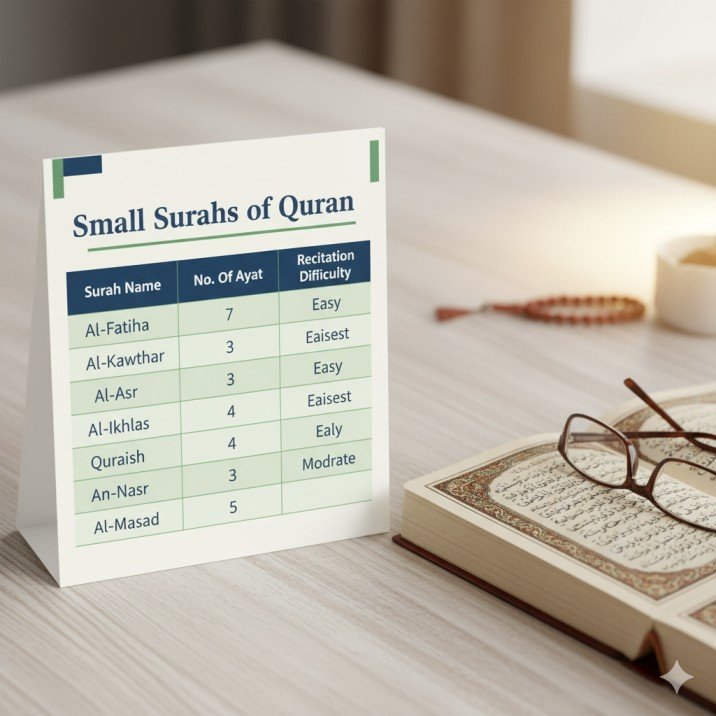
What Are the Small Surahs of the Quran?
The short Surahs are those chapters of the Quran with 7 Ayat (verses) or fewer. They are found primarily in the 30th Juz (Juz' Amma) and are among the most frequently recited chapters in daily prayers and Islamic life.
| # | Surah Name | Arabic | Ayat | Est. Memorization Time | Difficulty |
|---|---|---|---|---|---|
| 1 | Al-Fatiha | الفاتحة | 7 | 1–2 days | Beginner |
| 2 | Al-Kawthar | الكوثر | 3 | 1 day | Beginner |
| 3 | Al-Ikhlas | الإخلاص | 4 | 1 day | Beginner |
| 4 | Al-Nasr | النصر | 3 | 1 day | Beginner |
| 5 | Al-Masad (Al-Lahab) | المسد | 5 | 1–2 days | Beginner |
| 6 | Al-Kafiroun | الكافرون | 6 | 2–3 days | Intermediate |
| 7 | Al-Falaq | الفلق | 5 | 1–2 days | Beginner |
| 8 | Al-Nas | الناس | 6 | 2–3 days | Intermediate |
| 9 | Al-Asr | العصر | 3 | 1 day | Beginner |
| 10 | Al-Fil | الفيل | 5 | 1–2 days | Beginner |
| 11 | Quraish | قريش | 4 | 1 day | Beginner |
| 12 | Al-Ma'un | الماعون | 7 | 2–3 days | Intermediate |
*Memorization times are estimates for motivated beginners learning with a qualified tutor. Individual results vary.
The Easiest Surahs of the Quran to Learn
If you are just beginning your journey, two Surahs stand out as the most accessible starting points:
- Surah Al-Kawthar — Only 3 Ayat, short and rhythmically beautiful.
- Surah Al-Ikhlas — Only 4 Ayat, one of the most repeated Surahs in Islamic practice.
Both Surahs are foundational for daily prayer (Salah) and contain key Tajweed rules that set the stage for further learning. Want to understand the memorization process better? Read our detailed guide on the best way to memorize Quran for non-Arabic speakers.
Learning with a qualified Quran tutor makes all the difference.
The Most Important Surah Every Muslim Should Memorize
Surah Al-Fatiha — The Opening
The cornerstone of every Salah. No prayer is accepted without it.
Did you know the Surah? It is Al-Fatiha — the most important Surah in the entire Quran. Without Al-Fatiha, your prayer will not be accepted; it is an essential, non-negotiable part of every unit (Rak'ah) of Salah.
Al-Fatiha is also fundamentally a Du'a (supplication). Muslims recite it for Barakah (blessings) and Rizq (provision) — seeking increase in health, well-being, and happiness.
If you have any difficulty with Al-Fatiha's recitation or memorization, our tutors at Zaid Academy are ready to help you. Book your free trial session today.
Why Beginners Prefer to Start with Small Surahs
Beginners — especially non-Arabic speakers — always face challenges when reciting the Quran. The short Surahs of the Quran are the ideal starting point for several important reasons:
- They are short enough to memorize quickly, building confidence and momentum.
- They are used in every Salah, so learners practice them five times a day naturally.
- They are rich with Tajweed rules, giving learners a thorough practical foundation.
- They create a sense of achievement early in the learning journey, keeping motivation high.
For a full step-by-step roadmap, explore our resource: How do I learn Quran step by step? — Answers to 50 common questions.
Essential Tajweed Rules in the Short Surahs
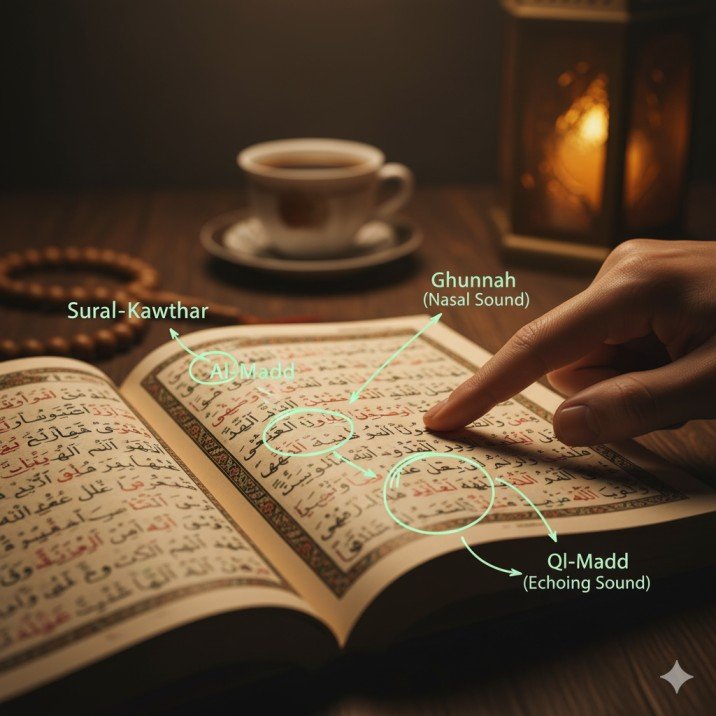
The short Surahs are laboratories of Tajweed. Each one is packed with rules that every reciter must master. Here are the five foundational rules you will encounter — and practice — from day one. For a deeper dive, read our beginner's guide: Read Quran with Tajweed for Beginners.
1. Ghunnah — Nasal Sound
Applies to Noon (ن) and Meem (م) when they carry a Shaddah. A full nasal sound must be sustained for two counts.
- "Innā" — in Surah Al-Kawthar
- "Innal" — in Surah Al-Asr
2. Al-Madd — Prolongation
Two key types appear in short Surahs:
- Madd Tabī'ī: Natural prolongation of 2 counts — the most common type.
- Madd 'Āriḍ Li'l-Sukūn: Flexible prolongation (2, 4, or 6 counts) when stopping at a word. E.g., stopping on "Al-Kawthar".
3. Qalqalah — Echoing Sound
Applies to the five Qutb Jad letters (ق ط ب ج د) when silent. The sound must echo or bounce.
- Kubra (Major): Stopping on "Aḥad" (Al-Ikhlas) or "Waqab" (Al-Falaq).
- Ṣughra (Minor): Silent Bā' in "Al-Ab-tar" (Al-Kawthar).
4. Noon Saakinah & Tanween
How a silent Noon or Tanween is pronounced before other letters:
- Iẓhār: Clear N before throat letters — "min khawf" (Surah Quraish).
- Ikhfā': Concealed N with light Ghunnah — "min sharri" (Al-Falaq).
5. Tafkhīm & Tarqīq — Heavy & Light Letters
Tafkhīm (Heavy): Applies to heavy letters like Ṭ in "A'ṭaynāk" and to the letter Rā' when open (Fat-ḥa) or silent after a Fat-ḥa.
Tarqīq (Light): All other letters are pronounced lightly. Critical insight: even when adjacent to a heavy letter, the light letter must remain light — e.g., the A in "A'ṭaynāk" stays light while the Ṭ remains heavy.
Mastering these rules in the short Surahs builds the complete Tajweed foundation needed for the entire Quran.
How to Recite the Small Surahs of the Quran

Proper recitation (Tilāwah) is a deeply spiritual act — not just reading.
Quran recitation — known as Tilāwah or Tartīl — is the vocal, rhythmic practice of reading the Holy Quran. It is a highly spiritual act of worship that goes far beyond simple reading; it is a connection between the believer and the Word of Allah.
Quran recitation must always be learned under the guidance of a qualified tutor who knows the rules of Tajweed. The student recites in front of the tutor, who listens carefully and corrects any errors in pronunciation, rhythm, or application of rules.
Important: Do not attempt to learn Quran recitation entirely on your own. Errors in Tajweed that go uncorrected become deeply embedded habits that are very difficult to fix later. The traditional method — reciting in front of a qualified teacher — has been the standard for 1,400 years for a reason.
The Story Behind Surah Al-Kawthar
Surah Al-Kawthar is only three Ayat — yet its story is one of the most profound in the entire Quran. Understanding the context of its revelation transforms how you recite it.
1. The Insult — The Context of Revelation
Two of the Prophet's ﷺ sons died in childhood. The Arab society of the time placed immense value on male heirs to carry on a family's legacy. A chief of the pagan Quraysh — Al-As ibn Wā'il — seized on this grief to publicly humiliate the Prophet ﷺ, calling him "Al-Abtar": "the one whose lineage is cut off." Their malicious claim was that without a surviving male heir, the Prophet's mission would die with him and his memory would be forgotten.
2. The Divine Response — The Message
Surah Al-Kawthar was revealed as a direct divine consolation and refutation. The word Kawthar means "abundance of good" and "profuse, unending blessings." One interpretation identifies Al-Kawthar as a magnificent river in Paradise promised exclusively to the Prophet ﷺ. Another — supported by Ibn Abbas — understands it as the vast abundance bestowed on the Prophet: prophecy, the Quran, his enduring honor, and the multitude of his followers across all generations. The final verse reverses the insult entirely: "Indeed, your enemy is the one cut off." The Prophet's opponents are the ones forgotten; the Prophet's ﷺ name is recited billions of times every single day.
3. The Command — The Path to Gratitude
The middle verse instructs: "So pray to your Lord and sacrifice." Gratitude for immeasurable blessings is expressed through sincere worship — Salah and sacrifice. This verse ties divine abundance directly to acts of devotion, establishing the eternal spiritual legacy the Prophet's ﷺ enemies could never erase.
Your Quran Journey Starts Here
Join thousands of students worldwide who are learning to read, recite, and memorize the Quran — with certified tutors, a structured curriculum, and a free first lesson.
🌙 Start My Free Trial LessonNo commitment required · Online · All ages & levels welcome