
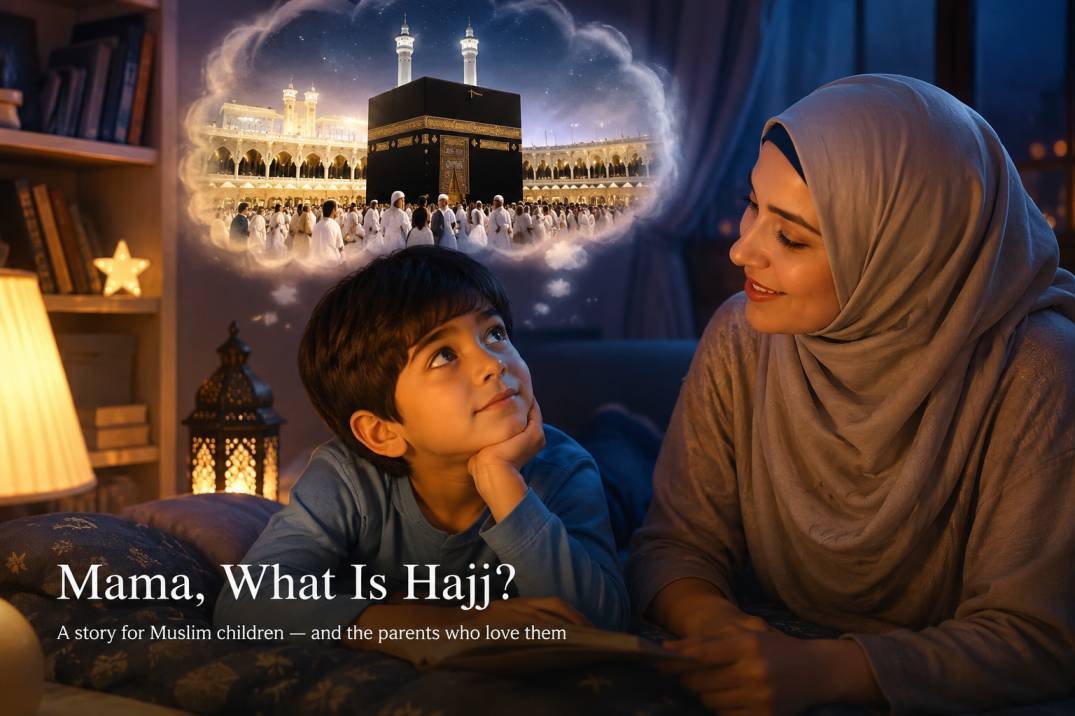
The question that changed their evening
It was a Thursday evening, and Omar was doing what he did most evenings — sitting beside his mother on the sofa while the news played quietly in the background.
Then something stopped him.
On the screen, millions of people were moving together in slow, enormous circles around a large black cube. All of them wore the same simple white cloth. There were old men and young women, children and grandparents — people from every country on earth — turning, turning, turning around this one extraordinary building in the middle of the most enormous crowd Omar had ever seen.
He tugged his mother's sleeve.
"Mama — what is that?"
His mother turned from her tea. She looked at the screen for a moment. Then she smiled — the kind of smile that told Omar this was going to be a long and beautiful answer.
"Come. Let me tell you the most important journey in the world."
"But first — what is Hajj?"
Omar's mother took a slow breath and began.
"Hajj is a pilgrimage — a very special journey that Muslims make to a holy city called Makkah, or Mecca, in Saudi Arabia. It happens every year during a month called Dhul Hijjah, which is the last month of the Islamic calendar."
"Is it like a holiday?"
"It is nothing like a holiday. It is one of the five pillars of Islam. Do you remember the five pillars?"
Omar counted on his fingers. Shahadah — declaring that Allah is One and Muhammad ﷺ is His Prophet. Salah — the five daily prayers. Zakat — giving to those in need. Sawm — fasting in Ramadan. And...
"And Hajj. Every Muslim who is healthy enough, and who has enough money for the journey, must go to Hajj at least once in their lifetime. It is a duty given to us by Allah."
"Why?"
"That is exactly the right question. And to answer it, I have to take you back thousands of years — to a man named Ibrahim."
Key fact — Hajj 2026
Hajj takes place on the 8th–13th of Dhul Hijjah every year. In 2026, the Day of Arafat — the heart of Hajj — falls on approximately 5 June. Muslims worldwide fast on this day even if they are not on pilgrimage. It is considered one of the most blessed days of the entire Islamic year.
The story that Hajj was built on
Ibrahim (AS): the man Allah trusted most
"Ibrahim — peace be upon him — was one of the greatest prophets Allah ever sent to this earth," Omar's mother said. "He was a man of extraordinary faith. From the time he was a young boy, he knew in his heart that the idols his people worshipped were made of stone and wood — that they could not hear, could not help, could not love. Only Allah could do those things."
"Did people believe him?"
"No. They were very angry with him. Some threw him into a fire — but Allah protected him, and the fire did not burn him."
Omar's eyes went wide.
"But the trial that tested Ibrahim most of all came much later — when Allah commanded him to take his wife Hajar and their baby son Ismail, and leave them in the middle of a desert valley called Makkah. No houses. No people. No water. Just sand and heat and an empty sky."
"Mama — why would Allah ask him to do that?"
"Because Allah was testing whether Ibrahim trusted Him completely. And Ibrahim did — with his whole heart, without hesitation."
Hajar and the miracle of Zamzam
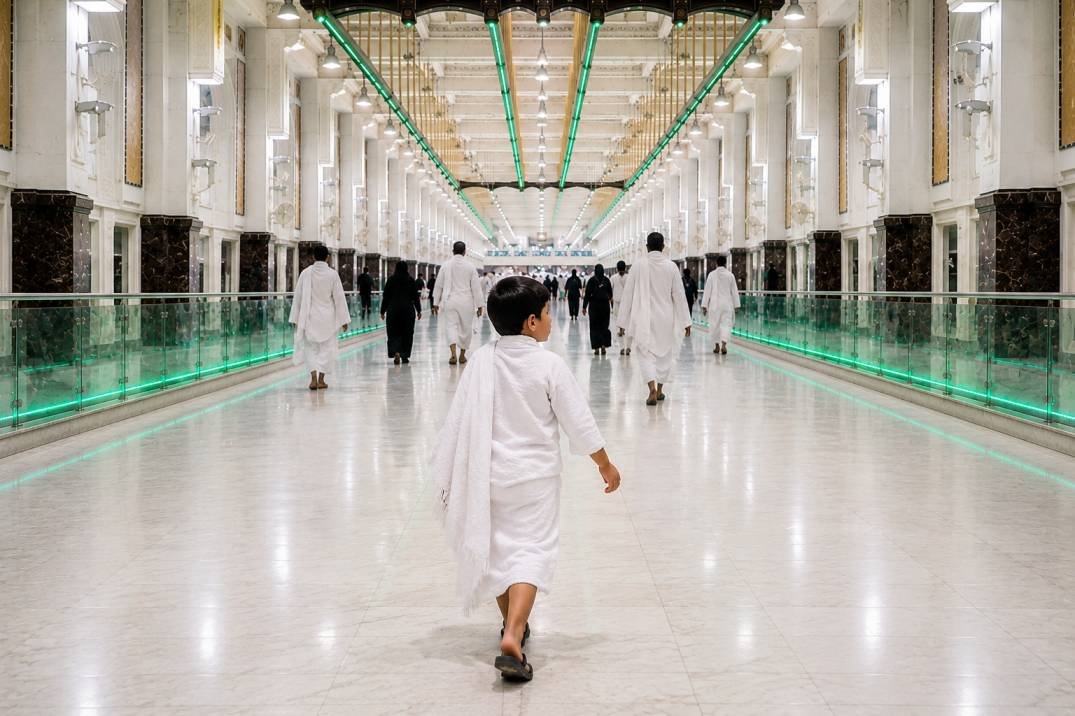
Between Safa and Marwa — the path every Muslim pilgrim walks in Hajar's memory
"So Ibrahim actually left them?"
"He did. And Hajar watched him walk away. She called after him: 'Ibrahim — are you leaving us here?' He could not turn back. She asked again: 'Did Allah command you to do this?' He nodded. And she said — and these words are among the most beautiful ever spoken — she said: 'Then Allah will not abandon us.'"
"Then Allah will not abandon us." — Hajar, wife of Ibrahim (AS)
"Ismail was a tiny baby, and Hajar had very little water. When it ran out, she saw two small hills — one called Al-Safa, and one called Al-Marwa. She ran between them, back and forth, seven times, desperately searching for any sign of water or help."
"Did she find any?"
"Something even better. While she searched, baby Ismail was kicking his little feet in the sand — and from under his feet, water began to spring from the ground. Clear, cold, beautiful water. That water is called Zamzam, and it is still flowing today, thousands of years later. Every single pilgrim who goes to Hajj drinks from it."
"The same water? From the same spring?"
"The very same."
Ibrahim's return — and the building of the Kaaba
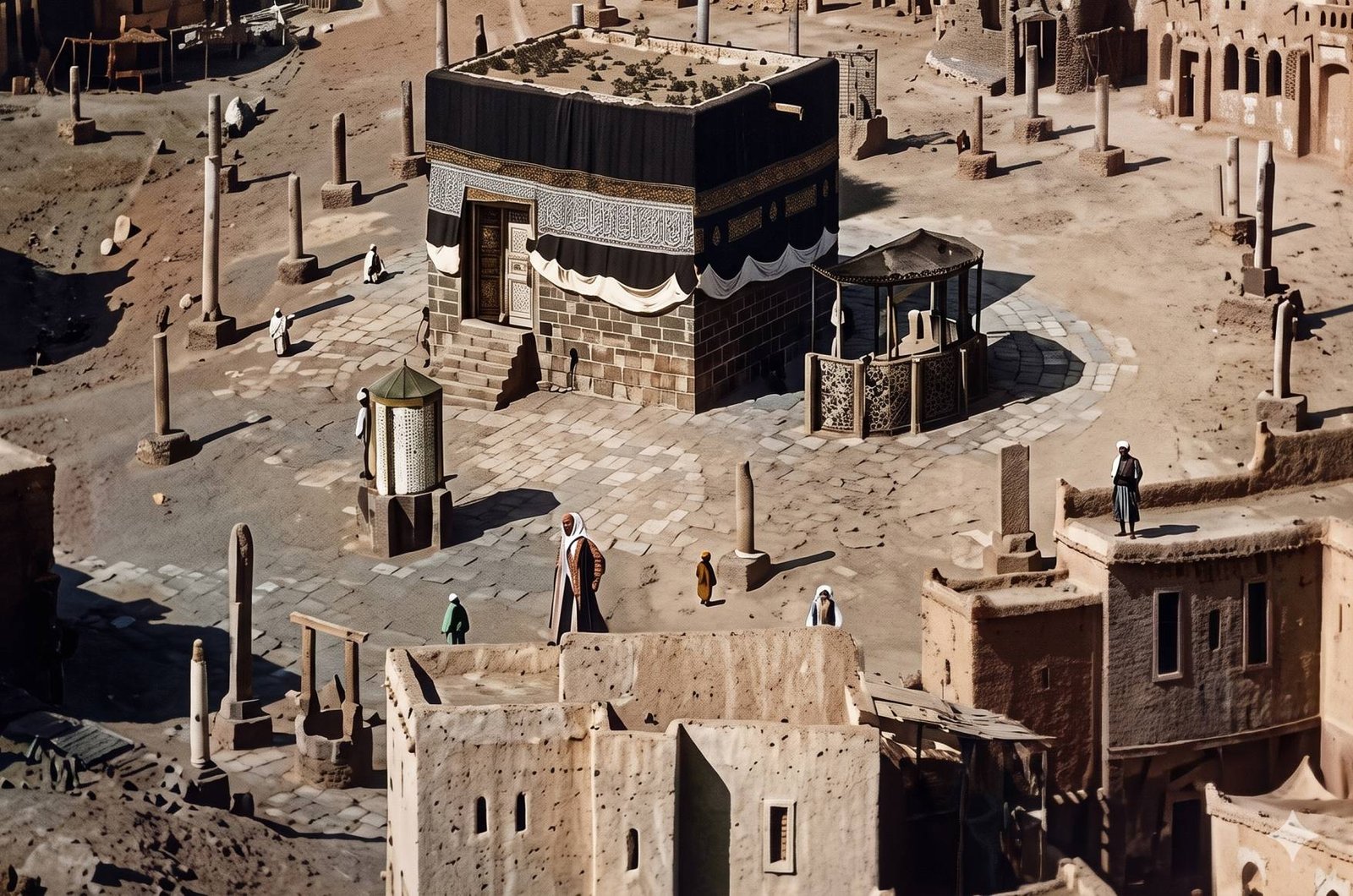
The Kaaba as it appeared in earlier centuries — the same house Ibrahim and Ismail built with their own hands, still standing at the centre of the world
"Years passed. Ismail grew up strong and wise in Makkah. And one day, Ibrahim returned. Allah gave him a new command: go to Makkah, and with your son, build a house of worship for Me."
"The black cube."
"Yes. That is the Kaaba — which means 'cube' in Arabic. Ibrahim and Ismail built it together, stone by stone, with their own hands. When they finished, Allah told Ibrahim to do one more thing."
"What?"
"To call all of humanity to come. To invite every person who would ever live, in every age and every country, to come to this house and worship Allah. He called with his voice — and Allah caused that call to reach every soul that would ever be born. That is why, when we go to Hajj today, we are answering a call that was made thousands of years ago."
"What does the Kaaba look like from nearby?"
"But Mama — what does it actually look like? Up close? If I walked right up to it?"
His mother smiled. "Close your eyes and imagine it."
"The Kaaba is a large cube-shaped building — about 15 metres tall. It stands in the centre of a vast open courtyard inside Masjid Al-Haram, the Grand Mosque of Makkah. From far away, it looks like an anchor point — the fixed centre around which everything else in the world turns."
"Up close, it is draped from top to bottom in a black silk cloth called the Kiswah. This cloth is renewed every single year and embroidered with verses from the Quran in threads of pure gold and silver. When you see it in the sunlight, the golden writing seems to float against the darkness of the silk."
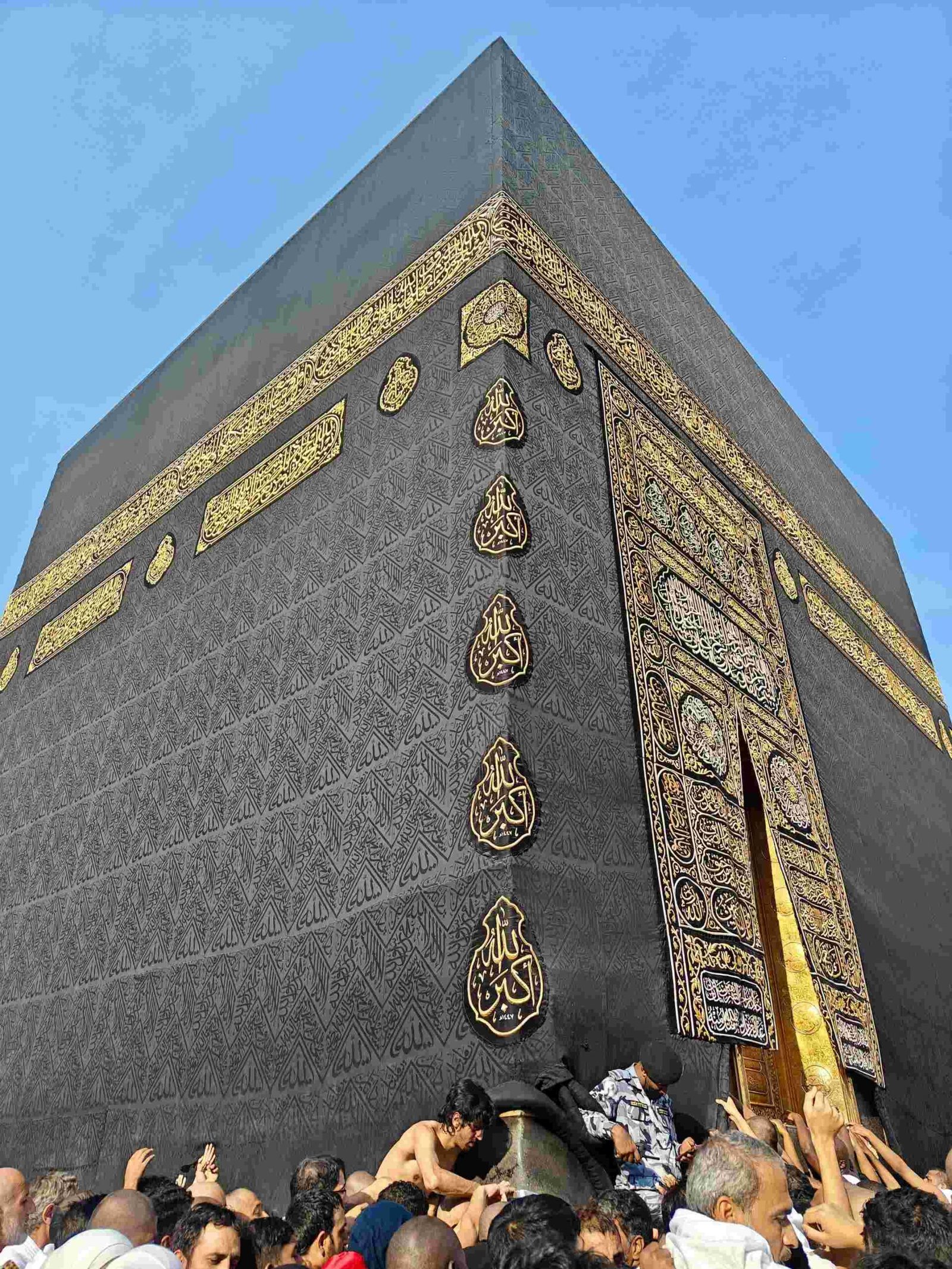
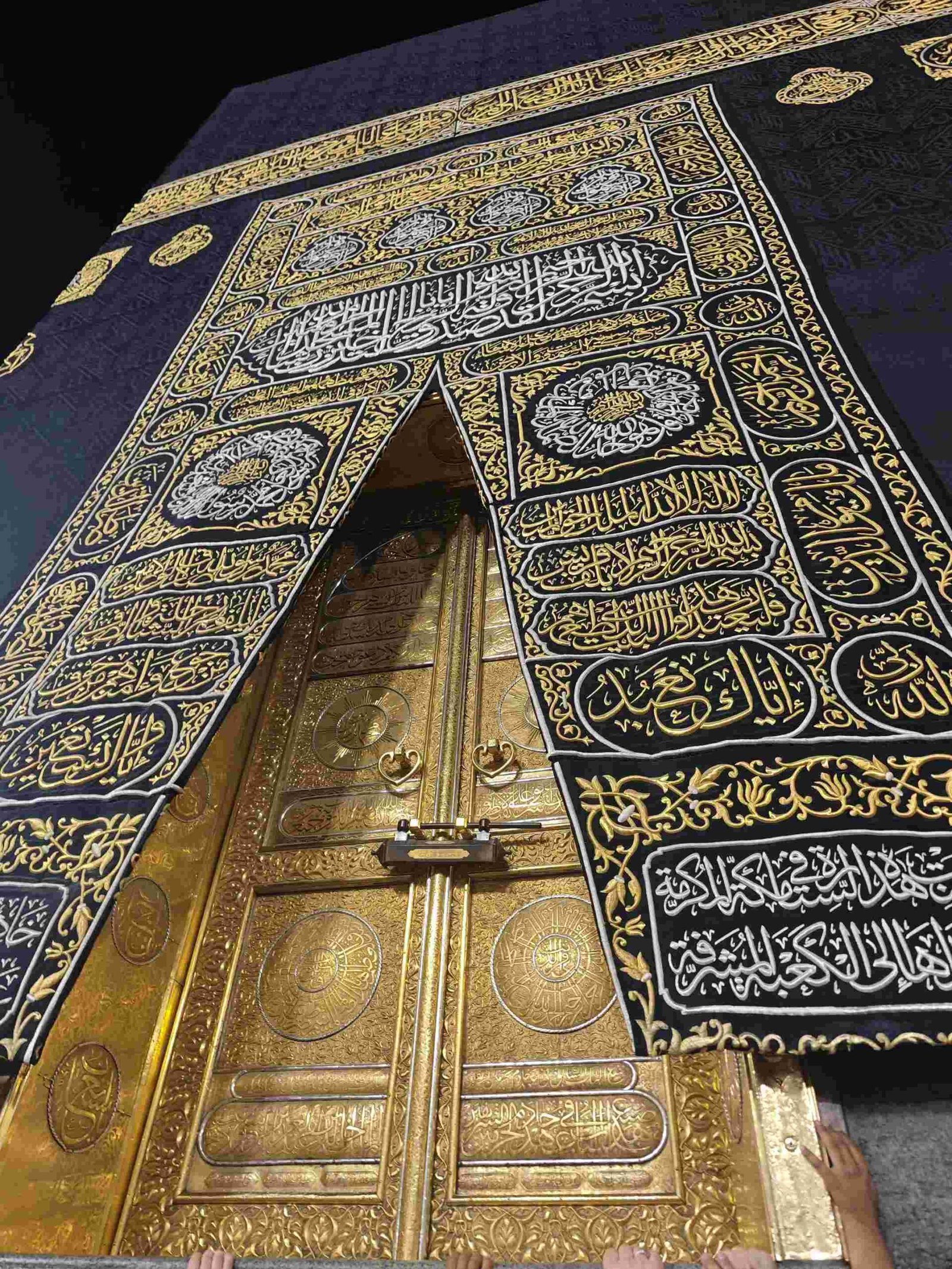
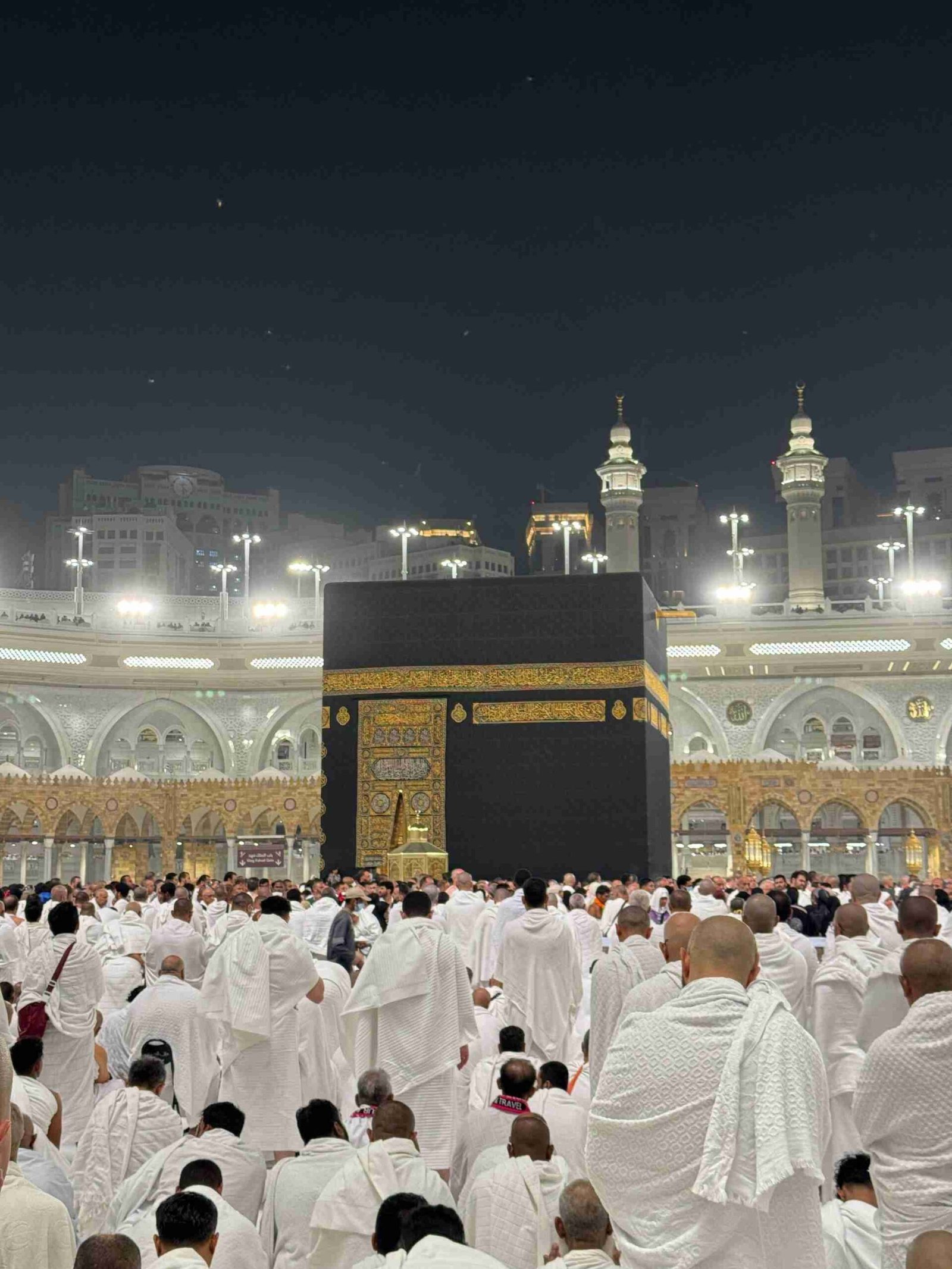
The Kaaba — the same cube, the same centre, the same call — seen from three angles
"In one corner, at the height of a person's hand, sits a dark stone called Al-Hajar Al-Aswad — the Black Stone. It is said to have come from paradise. Pilgrims try to touch or kiss it as they pass, as the Prophet Muhammad ﷺ did. Every Tawaf begins at the Black Stone."
"The Kaaba has a single door — elevated about two metres above the ground, gilded in gold. Only a very small number of people are ever permitted inside."
"What is it like when people first see it?"
"Many people cry. Even people who expected to cry are surprised by how much. You can prepare your whole life for the sight of it — and when you finally stand there, in that courtyard, watching the crowds flow around it like a river with no end, your heart does something you have no word for. It is not sadness. It is not happiness. It is something else entirely."
"The first sight of the Kaaba is unlike anything else on earth. Every pilgrim remembers it for the rest of their life."
The Kaaba — key facts
Dimensions: Approximately 15 metres tall, 12 metres wide, 10 metres deep.
The Kiswah: Remade every year on the 9th of Dhul Hijjah. Takes over 670 kg of raw silk and 120 kg of gold thread to produce. Replaced by a new cloth each Hajj season.
Al-Hajar Al-Aswad (the Black Stone): Set in the eastern corner, 1.5 metres from the ground. Pilgrims gesture toward it at the beginning of each circuit of Tawaf.
Masjid Al-Haram: The Grand Mosque surrounding the Kaaba can accommodate over 4 million worshippers at a time during the Hajj season.
The words Omar could not stop repeating
Later that evening, as his mother finished describing the Kaaba, Omar heard her murmur something under her breath. A quiet, rhythmic repetition — almost like a song. He had heard it before, on Islamic occasions, in videos, in prayers — but he had never stopped to ask what it meant.
"Mama. Those words you're saying. What are they?"
"The Talbiyah. The words that every pilgrim says from the moment they put on the Ihram — until they reach the stoning at Mina. Let me say it for you, slowly."
لَبَّيْكَ لَا شَرِيكَ لَكَ لَبَّيْكَ
إِنَّ الْحَمْدَ وَالنِّعْمَةَ لَكَ وَالْمُلْكَ
لَا شَرِيكَ لَكَ
Labbaykalā Shareeka Laka Labbayk.
Innal Hamda Wan-Ni'mata Laka Wal-Mulk.
Lā Shareeka Lak.
-
لَبَّيْكَ اللَّهُمَّ لَبَّيْكَ
Here I am, O Allah, here I am.
The pilgrim is saying: I came. I answered. I am present before You — completely, with everything I am. -
لَا شَرِيكَ لَكَ لَبَّيْكَ
I came because You called me.
There is no partner with You. I am here for You alone — not for anyone or anything else in this world. -
إِنَّ الْحَمْدَ وَالنِّعْمَةَ لَكَ
All praise and all blessing belong to You.
Everything I have — my health, my life, this journey itself — all of it came from You and belongs to You. -
وَالْمُلْكَ لَا شَرِيكَ لَكَ
All sovereignty is Yours alone.
You are King. There is nothing above You, beside You, or equal to You. My Hajj is for You alone.
Omar repeated the first line under his breath, slowly. Labbayk Allahumma Labbayk.
"It gives me goosebumps."
"It gives everyone goosebumps. Now imagine two million people saying those same words at the same time. Some have waited their entire lives to say it. Some are saying it for the first time. Some know it may be the last time. And all of them are saying: Here I am, Allah. I came because You called me."
Pilgrims repeat the Talbiyah continuously from the moment they enter Ihram — on the road, on the bus, walking between sites, in quiet moments before sleep. It becomes, as one scholar said, less a recitation and more a breath. It is the sound of Hajj — the reply to a call that Ibrahim sent out thousands of years ago, and that Muslims are still answering today.
For children who have already begun memorising the small surahs of the Quran, the Talbiyah is a natural next step in that same journey. Both are acts of Arabic memorisation that build a living connection between a child's tongue and their faith — words that do not stay on the page, but travel with a person through their whole life.
"Ibrahim called. Every Muslim who ever walked to Hajj was answering. When a pilgrim says Labbayk — they add their voice to a chain that goes back to the beginning of this story."
"Why do Muslims face the Kaaba every day?"
Later, Omar watched his mother stand for Isha prayer. She turned, as she always did, toward one corner of the room.
"Mama — are you facing Makkah right now? Even from here, in our house, in London?"
"Yes. Every Muslim who prays anywhere on earth faces the Kaaba. It is called the Qiblah — the direction of prayer."
Every Muslim who has ever prayed has turned toward the same single point — the Kaaba in Makkah. At any given moment, in every time zone on earth, someone is praying and facing it. The Kaaba is the one fixed centre of the Muslim world.
"So we don't have to go to Hajj to face the Kaaba. We face it every single day."
"Exactly. You don't have to be standing there to belong there. Every time you pray, you are already facing home."
This is one of the most profound truths of Islamic worship. Hajj is the physical journey to the Kaaba — a journey a Muslim may make once in a lifetime. But Salah is the daily turning of the heart toward that same point, repeated five times a day, every day, for an entire life. A Muslim who has never left their city has still faced Makkah tens of thousands of times. The Kaaba does not belong only to those who can reach it. It belongs to every Muslim who turns toward it and says Allahu Akbar.
"Every time we pray, we are already facing home."
The sacred places of Hajj
"Mama, where exactly do the pilgrims go? Is it all in one place?"
"No — Hajj takes place across several sacred locations, all near Makkah. Pilgrims move between these places over five days, covering approximately 25 kilometres in total."
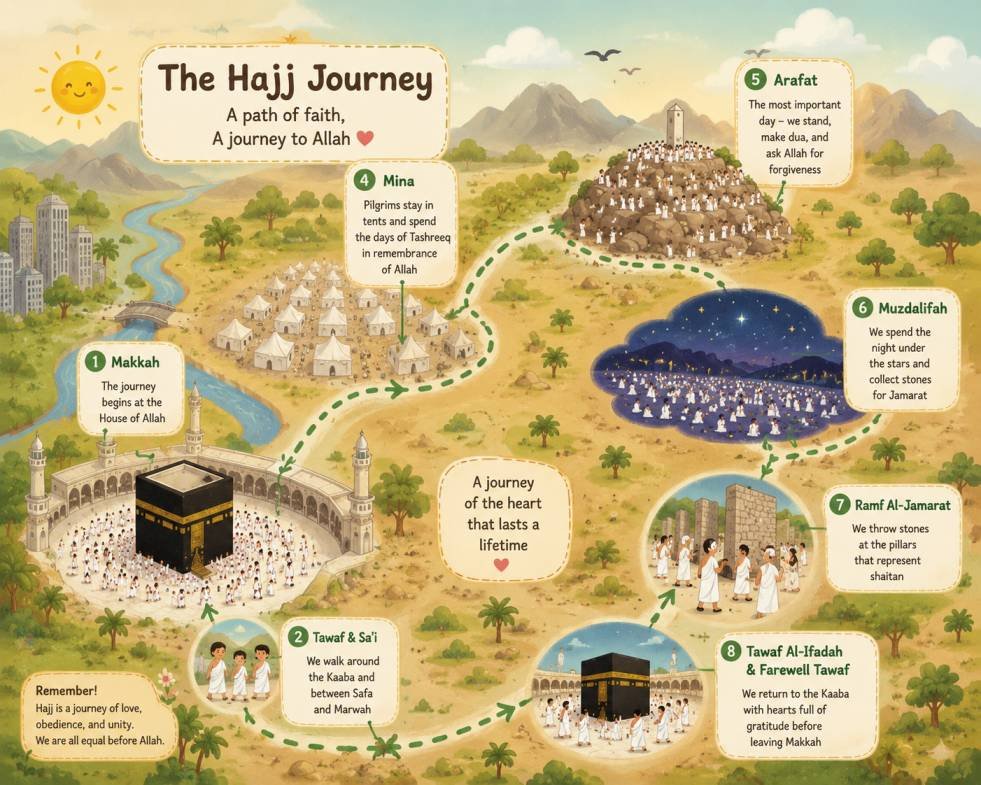
The sacred geography of Hajj — from the Kaaba in Makkah to the plain of Arafat, covering 25 km over five days
The four sacred sites of Hajj
Makkah — The Kaaba, Masjid Al-Haram, and the hills of Safa and Marwa. The spiritual centre and starting point of the pilgrimage.
Mina — A valley approximately 5 km east of Makkah. Pilgrims stay here on the night of the 8th Dhul Hijjah and return on the 11th–13th for the stoning of the Jamarat pillars.
Muzdalifah — An open plain between Mina and Arafat. Pilgrims sleep here under the open sky on the night of the 9th Dhul Hijjah and collect their pebbles.
Plain of Arafat — Approximately 15 km east of Makkah. The Day of Arafat (9th Dhul Hijjah) is the heart of Hajj. No Hajj is valid without standing here.
The modern Hajj — arriving at the house of Allah
"Today," Omar's mother said, "nearly two million Muslims from over one hundred and eighty countries travel to Makkah every year. Some save for their entire lives to make this journey."
"Two million? That's — imagine your whole school. Ten thousand times."
"And every single one of them wearing the same clothes."
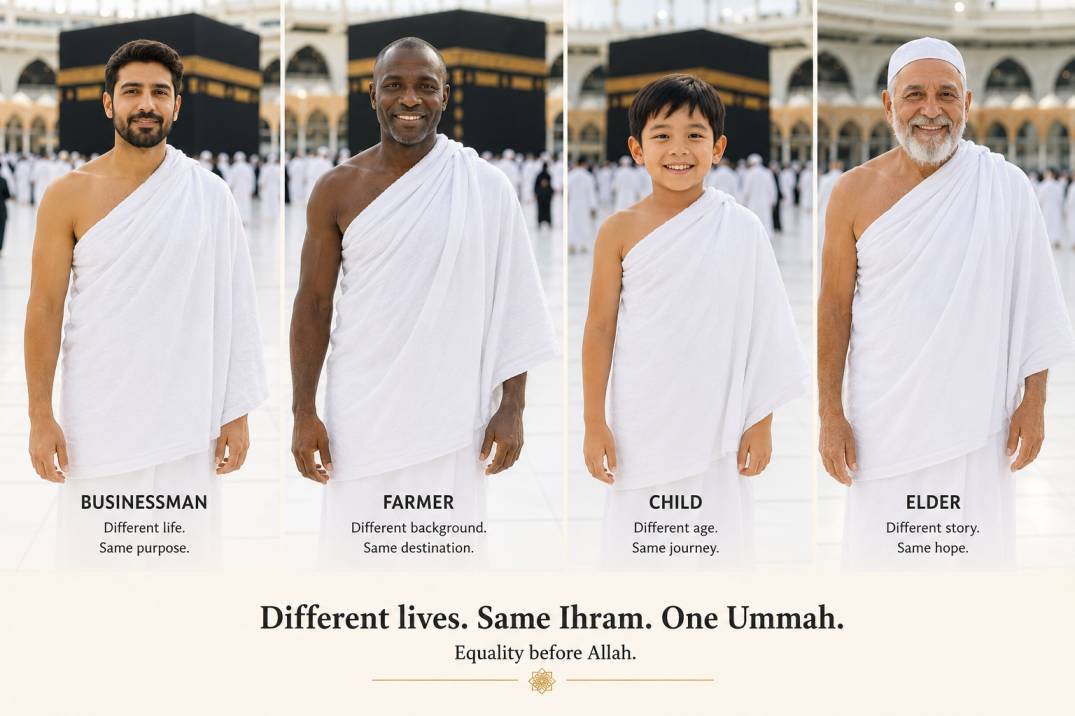
Ihram — the simple white cloth that makes every pilgrim equal before Allah, from the wealthiest to the humblest
"When a pilgrim enters the sacred zone around Makkah, they enter a special state called Ihram. Men wrap themselves in two simple white cloths — no stitching, no buttons, nothing sewn. Women wear modest, plain clothing. And from that moment, every person is equal. There is no king and no cleaner, no rich person and no poor person. Everyone stands before Allah exactly the same way."
"I think that's the most fair thing I've ever heard."
"That is exactly what it is meant to be."
In the state of Ihram, the pilgrim may not cut their hair or nails, use perfume, argue, or raise their voice in anger. They are guests in the house of Allah — and a guest in the house of Allah behaves with the gentlest of manners.
Every step of the Hajj journey
"Walk me through it, Mama. Step by step. What actually happens?"
"Alright," she said. "Let me tell you each part."
"Will we go one day, Mama?"
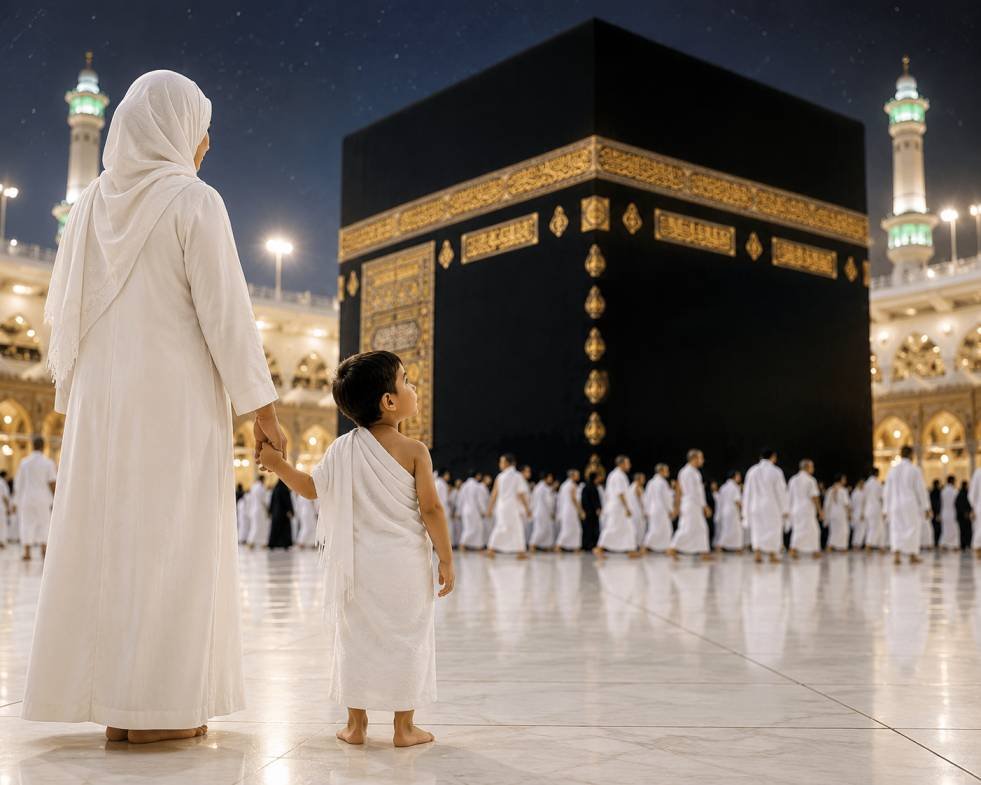
One day, Insha'Allah — the dream that every Muslim carries in their heart
Outside, the news had long since moved on. But in this room, on this sofa, the world had become very large and very beautiful.
Omar's mother closed her eyes for a moment before she spoke.
"Every Muslim who goes to Hajj comes back changed. Not because the journey is comfortable — it isn't. Two million people in the heat, walking for miles, sleeping on the ground. It is difficult. But when you stand on the plain of Arafat, surrounded by people from every corner of the earth, all in white, all saying the same words, all asking the same God for forgiveness — something happens inside you that you cannot describe."
"What happens?"
"You understand that you are not alone. That you were never alone. That every Muslim who ever lived — your great-grandparents, people from centuries ago, people who will come after us — they all answered the same call. Labbayk Allahumma Labbayk. Here I am."
Omar looked back at the TV screen for a long moment. The images were gone now. But he could still see them in his mind — the white sea of people, the great black cube at the centre, the slow and immense turning.
"I want to go. When I'm older. I want to stand there at Arafat and say those words."
His mother put her arm around him.
"Then we will prepare you. We will learn. We will understand what we believe and why we believe it. And when the time comes — Insha'Allah — you will stand there. And you will know exactly what you are saying."
For parents reading this with your child
Omar's question — "Mama, what is that?" — is one of the most important questions a Muslim child can ask. Your answer shapes far more than their knowledge of Hajj. It shapes their relationship with their faith, their history, and their identity as a Muslim in a world that rarely stops to explain these things.
Many Muslim parents in the UK and USA find that pairing Islamic stories with structured Quran learning gives children the fullest understanding — they hear the stories of Ibrahim and Hajar, and they also learn to recite the words of the Quran in which those stories are preserved. Zaid Academy's online Quran recitation and Tajweed course for kids is taught by Al-Azhar certified teachers in live, one-on-one sessions designed for children of all levels — from complete beginners to those already reading confidently.
Notes for parents
Hajj 2026: The Day of Arafat falls on approximately 5 June 2026. Even if your family is not on Hajj, fasting on this day is strongly recommended — and a meaningful way to involve your children in the season.
Age guidance: Children as young as four understand the story of Ibrahim through its emotions: trust, courage, love. The theological detail grows with them. Start with the feeling, not the facts.
Belonging before going: A child who has never been to Hajj already belongs to it. They face the Kaaba five times a day. The Talbiyah can be taught as a song. These things are their inheritance — not for when they grow up. Now.
Structured Islamic education: Learning the stories of the Prophets, understanding the pillars of Islam, connecting with this history week by week — this is how belonging becomes something felt, not just known. If you are teaching your child at home, our Islamic homeschooling curriculum guide provides a structured framework for covering Hajj, the pillars of Islam, and Quranic stories alongside your child's regular schooling.
Frequently asked questions
Hajj is the annual Islamic pilgrimage to Makkah (Mecca) in Saudi Arabia. It is the fifth pillar of Islam and is obligatory once in a lifetime for every Muslim who is physically and financially able. It takes place during Dhul Hijjah — the final month of the Islamic calendar — and involves sacred rituals that trace the footsteps of the Prophet Ibrahim (AS) and his family.
The Kaaba was built by the Prophet Ibrahim (AS) and his son Ismail (AS) by the command of Allah. Muslims face the Kaaba — the Qiblah — in every Salah prayer, wherever they are in the world. The Kaaba is covered by a black silk cloth called the Kiswah, embroidered with golden Quranic verses, which is renewed every year during Hajj season.
Labbayk Allahumma Labbayk means "Here I am, O Allah, here I am." It is the Talbiyah — the declaration pilgrims make from the moment they enter the state of Ihram until the stoning ritual at Mina. It is the Muslim's response to Ibrahim's ancient call to Hajj, and one of the most emotionally powerful phrases in all of Islamic worship.
The Day of Arafat is the 9th of Dhul Hijjah and the most important day of Hajj. Pilgrims stand on the plain of Arafat from noon until sunset in prayer and repentance. The Prophet Muhammad ﷺ said: "Hajj is Arafat." Without this standing, Hajj is not complete. Muslims worldwide who are not on Hajj are strongly encouraged to fast on this day.
Zamzam is the sacred spring that miraculously appeared beneath the feet of the baby Ismail when his mother Hajar ran desperately between the hills of Safa and Marwa searching for water. The spring has been flowing for thousands of years and is located inside Masjid Al-Haram in Makkah. Every pilgrim who performs Hajj or Umrah drinks from it.
The simple white garment worn during Hajj is called Ihram. It represents equality before Allah — in the state of Ihram, there is no distinction between rich and poor, ruler and cleaner. All stand identically before their Creator. It also serves as a reminder of the shroud and of the Day of Judgement, when every person will stand before Allah with nothing but their deeds.
Sa'i is the act of walking seven times between the hills of Al-Safa and Al-Marwa inside Masjid Al-Haram. It commemorates the courage of Hajar, who ran between these hills searching for water for her infant son Ismail. It is a required ritual of both Hajj and Umrah. Today the hills are enclosed within the mosque and connected by a wide, air-conditioned walkway approximately 450 metres long.
Children may attend Hajj with their families and it is considered a blessed and rewarding experience. However, Hajj only becomes obligatory when a person reaches adulthood, is physically able, and has the financial means. A child who performs Hajj before reaching puberty has performed a recommended act of worship — but will still be required to perform Hajj again as an adult when they are able.
Give your child more than a story. Give them a teacher.
At Zaid Academy, our Al-Azhar certified teachers explain Islam the way Omar's mother explained Hajj — one story at a time, one question at a time, with patience and love. Live, one-on-one Quran classes for children in the UK, USA, Canada, and the Netherlands.
Explore the Quran course for kids